
Measured results > Promised results
Each of these engagements started with a common question:
Where is friction costing money?
These systems are just a few examples of what happened once we found the answer.
Financial Recon + Dashboard
Client:
Market-trading company
The friction:
Reconciling financial data incoming from a vast POS network totaling thousands of daily transactions consumed hours of skilled staff time every week. High-touch, error-prone, and labour-replication for each geographic market.
The system:
An integrated reconciliation and dashboard processing the data across the relevant platforms at consistent quality, turning a multi-hour manual task into a few minutes of review.
The return: 6× return year 1
Consistent on-time close-outs and error exposure eliminated.
Demonstrates:
The cost of manual reconciliation was very high, but the real price was the risk sitting inside finicky multi-touch spreadsheets.
Removing the manual touch removed both.
Document Intelligence for Regulated Supply Chains
Client:
Food-chemicals merchant (regulated supply chain)
The friction:
Every product this business brings to market arrives wrapped in paperwork it didn't write: certificates of analysis, safety data sheets, technical specs, GMO, allergen declarations, etc - all authored by suppliers, in their formats, in their languages, and rarely compliant with the destination country's regulations.
Only one in five documents was usable as received. All need ed attention from the most technically qualified people in the business; people who should be on product, not retyping PDFs.
Onboarding a new supplier took days.
The exposure was commercial as well as operational.
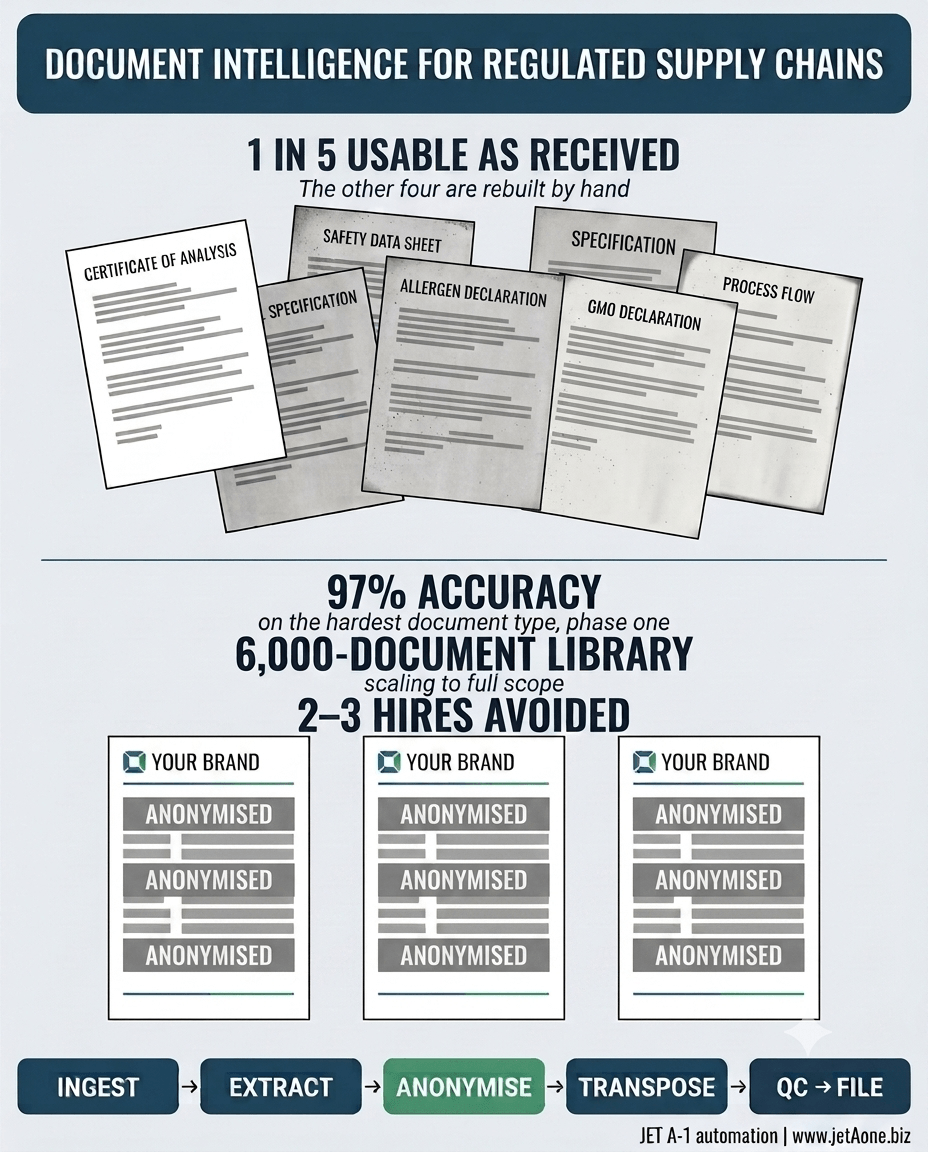
Supplier names leak onto customer-facing documents. One customer worked out who the supplier was and went direct; a relationship worth around $1.5m a year, gone.
If you source and resell, your supplier list is the business, and it's a risk many businesses never price in.
The system:
A document intelligence pipeline built on a clear division of labour.
Deterministic rules handle everything with a fixed, correct answer: extraction, anonymisation, formatting, traceability, filing, while AI reasoning is confined to the narrow judgement calls that genuinely need it.
Supplier identity is stripped everywhere it hides: letterheads, narrative text, disclaimers, stamps, signatures - while the fields required for traceability are preserved.
A quality-control layer checks each document before filing: completeness, format, branding, and confirmation that no supplier identity has survived.
Human review (HITL) sits above it and is risk-weighted: sampled across the general library, and applied to every document on nominated high-sensitivity products.
Where source data is absent, the system says so rather than inferring it. Every value traces back to the document it came from, which is what makes the output defensible under audit.
The return: 97% accuracy in phase 1 - a result originally targeted for phase 3.
Days of skilled manual work become minutes, and skilled attention moves from authoring every document to reviewing where it matters most.
The pipeline is live and scaling toward the client's full 6,000-document library; a volume that would otherwise have required two to three additional hires to process to this standard.
The library becomes searchable in plain language: ask a question, get an answer with the source document attached. And because document types and templates are configuration rather than code, moving the system to a different regulated industry is a scoping exercise, not a new build.
And the exact failure mode that cost the earlier customer relationship is now closed by design, not by policy.
Demonstrates:
This is what disciplined AI deployment looks like inside a regulated process: deterministic rules do the work wherever the answer is fixed, and AI reasoning is applied only where judgement is genuinely needed, within boundaries it cannot cross.
When qualified people spend their week rebuilding other people's documents, that is a system problem, not a staffing problem.
Proposal Generator
Client:
Digital marketing agency
The friction:
Every new proposal was built from scratch, regardless of it's value or weight. Pulling scope, pricing and terms together manually
Accumulated multi-hours of time and often under deadline pressure from a live sales conversation.
Quality varied with who wrote it and how rushed they were.
The system:
A proposal generation system trained on the agency's own scope, pricing and tone.
During or immediately after a discovery call, the team keys in the essentials and the system produces a professional, consistent proposal in moments, ready to send.
The return: 12× return within the first year
Quote-to-client time consistently cut from days to minutes.
Demonstrates:
The highest-friction work is often the most repeatable - and the most repeatable work is exactly what a proven system should be doing, not your valuable people.
Institutional Knowledge & Policies as Self-service
Client:
Field-marketing company
The friction:
Client-facing sales officers distributed state-wide and representing a regulated product require immediate, detailed-product support when a prospect / client asks a question they've not previously encountered. Phone calls to the team-lead at regional HQ have to be answered right away to maintain prospect interest; but that doesn't always happen. Result: a sale is missed or reputation is eroded. An unacceptable bottleneck.
The system:
An AI-driven RAG service via a WhatsApp interface. An expert knowledge assistant to sales staff, perpetually accessible, trained on the business's own product, pricing, policy and process information - delivering instant, accurate answers, and escalating to the team lead if that is needed.
The return: an extraordinary +2300% one year
Measured on cost saved and EXCL additional revenue generated, reputation and risk management. This is our highest ROI delivery to date.
Demonstrates:
Key knowledge bottle necks = business fragility, however capable those individuals are. Knowledge held in a system is resilience and liberation.
Client Onboarding and KYC
Client:
Cash-management company (regulated fin-services)
The friction:
Rigorous KYC compliance requirements meant onboarding was slow, heavily manual for both clients and admin team. Created an unprofessional image and real compliance risk if anything was missed or mismatched.
The system:
A digital, at-source onboarding system ensuring all required information and documentation is captured correctly before service activation. Compliance, or escalation, built into the process.
The return: payback within a quarter
Onboarding time materially reduced; compliance risk exposure significantly lowered.
Much easier for clients to engage.
Demonstrates:
In a regulated environment, the fastest process and the safest process are usually the same process, because both result when removing manual handling, not adding manual checking.
Multi-message Transmission Group Comms
Client:
Mass Recruitment and Training organisation
The friction:
Coordinating time-sensitive mass-group communications across multiple dispersed teams relied on manual messaging, repeated constantly, creating a fulltime requirement for staff that should have gone to higher-value work.
The system:
A world-unique automated group communications system on the WhatsApp platform handling routine coordination and updates, liberating staff from tedious and after-hours duties.
The return: payback within a half year
Team members redirected from continual and repetitive coordination to higher-value work.
Demonstrates:
Friction doesn't always look like a broken process, more often it is your most capable people doing under-skilled repeatedly.
Vendor Onboarding and Verification
Client:
Listed Property Development company
The friction:
Coordinating vendor details needed to be 100% correct for compliance and audit purposes, verified via an external integrity check; a manual, error-prone process with real downside if something slipped through.
The system:
An onboarding workflow integrated directly to external 3rd-party verification, automatically matching returned checks to the vendor record. Verification built into onboarding rather than bolted on afterward.
The return: meaningful annual time savings
More important: audit-ready by default rather than by scramble.
Demonstrates:
The best compliance systems don't feel like compliance - they feel like the process working properly, with the audit trail as a byproduct rather than the point.
Each of these results began with an assessment, not a guess.
Where is your business leaking value?
Too soon to speak with us?
Do an auto-assess in ~10min
To whom are we sending your audit report?

Privacy Policy: We hate spam and promise to keep your email address safe