
Flexibility v Accuracy in AI
[a layman's guide]
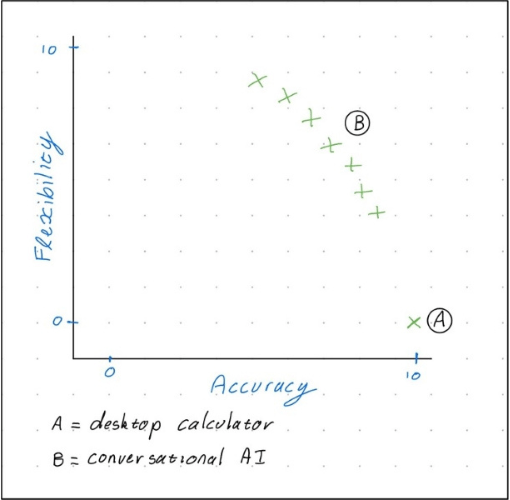
When we humans need to be particularly accurate with a piece of work, it is necessary for (most of) us to slow right down, focus carefully and work through the problem procedurally. On the other hand our trusty (and dusty) desktop calculator doesn’t need to slow down at all in order to deliver 100% accurate output 100% of the time. The calculator never flashes a warning:
I can make mistakes. Double check the response But when we engage with a conversational AI (c-AI) like Claude, ChatGPT, etc at each delivery it will post such a warning.
Why?
Flexibility is the answer. The amazing power of the c-AI is its flexibility, and that’s also its weakness. Just as you wouldn't (shouldn’t) perform brain surgery while simultaneously planning your vacation, you can help the c-AI deliver more accurate results by directing its focus appropriately. While AI doesn’t actually ‘think’ like a human, it does behave in a similar way and when we need for it to provide us accurate and dependable results we have to assist it to focus.
How?
It’s not complicated. 1.Clear Prompting · Define the scope clearly, just as you would brief a human colleague · Use two-shot prompting (ie showing examples) - think of it like training a new team member by demonstration. · Start with a clear role definition; similar to how you might yourself tackle a new problem by mentally ‘putting on your accountant hat’ as you begin the work 2. Engage in Focused Conversation · Guide the interaction like you would a brainstorming session that needs to converge on specific solutions · Build context progressively, just as you would in a human conversation · Keep the discussion centered on the core objective 3. Verification Steps · Ask for explanations of reasoning (like having a colleague walk you through their thought process) · Cross-reference critical information · Use multiple approaches for important queries, just as you might double-check your own work Of course, you can ask the c-AI itself how best for you to guide it to a result. This is a useful way to learn – just be sure to follow it’s guidance carefully. And, be careful how you ask :)
..
© 202x | JET A-1 automation